Article: Diamond Stud Earrings Size Guide: What Each Carat Size Looks Like on the Ear
Diamond Stud Earrings Size Guide: What Each Carat Size Looks Like on the Ear
Quick Summary
- Diamond stud sizes are sold by total carat weight (cttw) — a 2 cttw pair is two 1-carat stones, one per ear.
- Face-up size is what you actually see: a 1-carat round stone measures about 6.5 mm across, a 0.50-carat stone about 5.2 mm.
- 1 cttw is the everyday sweet spot for most people; 2 cttw is the classic "noticeable" size; 3–4 cttw makes a statement.
- Cut quality, setting, and your earlobe size change how big a stud looks — often more than a small step up in carat weight.
- At The Diamond Channel, lab grown round diamond studs run from 0.50 cttw ($249.99) to 10 cttw, in 14k white or yellow gold, with push-back or screw-back posts.
Shopping for diamond stud earrings and trying to picture what "2 carat" actually looks like on an ear? You are not alone. Carat is a weight, not a size, and two pairs with the same carat weight can look different depending on cut and setting. This guide translates every popular stud size into millimeters, shows you how each one looks worn, and helps you pick the right size for your ear, your lifestyle, and your budget.

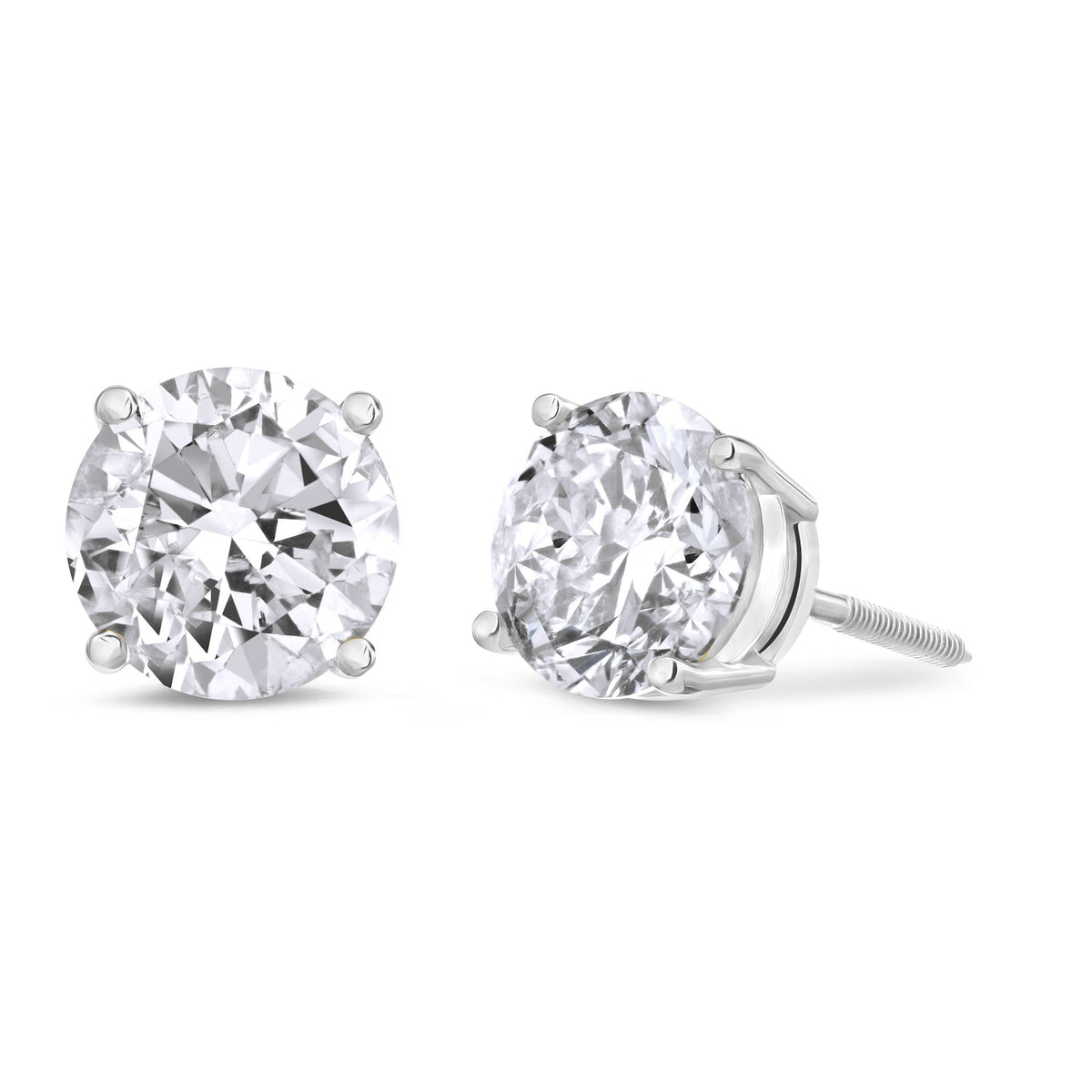
Our lab grown round studs from the front and the side — note the four-prong setting and the threaded screw-back post.
What Does "cttw" Mean in Diamond Stud Earrings?
Stud earrings are priced and sold by carat total weight, written as cttw. That number is both stones added together:
- 1 cttw pair = two 0.50-carat diamonds
- 2 cttw pair = two 1-carat diamonds
- 4 cttw pair = two 2-carat diamonds
This is the single most common point of confusion we see. If you want a "1 carat stud" in each ear, you are shopping for a 2 cttw pair. If a price looks too good to be true for the size you imagined, check whether the carat weight is per stone or per pair.
Carat Weight vs. Millimeter Size: Which One Matters?
What your eye reads as "big" is the stone's face-up diameter in millimeters, not its weight. A well-cut round brilliant shows its size on top; a deep-cut stone hides weight underneath where nobody sees it. That is why this guide gives you both numbers for every size — and why cut quality matters as much as carat, something we cover in depth in our complete guide to the 4Cs of diamonds.
Diamond Stud Earring Size Chart: Carat to Millimeters
Here is the full size chart for round brilliant studs. Diameters are industry-standard approximations for a well-cut round stone — the exact measurement of your pair is listed on its certificate and varies slightly stone to stone.
| Pair (cttw) | Per Stone | Diameter (mm) | How It Looks on the Ear | TDC Lab Grown Price* |
|---|---|---|---|---|
| 0.50 cttw | 0.25 ct | ~4.1 mm | Delicate sparkle; ideal for second piercings and small lobes | $249.99 |
| 1 cttw | 0.50 ct | ~5.2 mm | The everyday classic — visible, polished, never too much | $349.99 |
| 1.25 cttw | 0.62 ct | ~5.6 mm | A step up in presence, still office-easy | $399.99 |
| 1.50 cttw | 0.75 ct | ~5.9 mm | Noticeably brighter; a favorite first "real" pair | $499.99 |
| 2 cttw | 1.00 ct | ~6.5 mm | The statement standard — reads clearly across a room | $799.99 |
| 3 cttw | 1.50 ct | ~7.4 mm | Covers most of the lobe; evening-ready sparkle | $1,299.99 |
| 4 cttw | 2.00 ct | ~8.1 mm | Bold, red-carpet presence; IGI certified at TDC | $1,999.99 |
| 5 cttw | 2.50 ct | ~8.9 mm | Maximum coverage for larger lobes | — |
| 6 cttw | 3.00 ct | ~9.4 mm | Full-lobe, high-jewelry look | $2,499.99 |
*Prices shown are for our Lab Grown Round Diamond Stud Earrings in 14k gold, checked November 2026 — see the product page for current pricing. Pairs above 5 cttw continue to 8 cttw ($3,299.99) and 10 cttw ($4,999.99).
How Big Is Each Stud Size on the Ear?
0.50 to 1 cttw: The Delicate, Everyday Sizes
At roughly 4–5 mm per stone, these sizes sit close to the lobe and read as a clean point of light. They are the right call for second or third piercings, smaller earlobes, younger wearers, and anyone who wants a pair they truly never take off — including to sleep, shower, and work out. If you are buying a first pair as a gift and are not sure of her style, 1 cttw is the safest, most-worn size we sell.

Oval studs face up larger per carat than rounds — one reason elongated shapes are having a moment.
1.50 to 2 cttw: The Sweet Spot Most People Choose
This is where studs stop being an accent and become the jewelry moment. A 1-carat stone per ear (2 cttw, about 6.5 mm) has the diameter of a pencil eraser, catches light when the wearer turns her head, and photographs beautifully. Most of our customers who upgrade from a smaller pair land here — including many who start with our full earrings collection intending to "just look."
3 to 4 cttw: Statement Size, Done Right
At 7.4–8.1 mm per stone, the diamond covers most of an average lobe. Two things matter more at this size: cut (a large, poorly cut stone looks dull, while an excellent cut looks like a spotlight) and backing — heavier studs should sit upright, not droop, which is why we recommend a screw-back or a supportive push-back at 3 cttw and up. Every TDC pair over 4 cttw ships with an IGI certificate; standard pairs carry a DIS certificate.
5 cttw and Up: Full-Lobe and High-Jewelry Territory
From 5 cttw to our largest 10 cttw pair, you are choosing presence. These sizes suit larger lobes and special-occasion dressing, and because lab grown diamonds cost a fraction of mined stones of the same size, they are the sizes where lab grown changes what is possible on a real budget — read more in our guide to lab grown vs. natural diamonds.
What Else Changes How Big a Stud Looks?
Cut Quality
An excellent-cut round returns more light to the eye and measures its full diameter. Two 1-carat stones can differ by half a millimeter face-up — visible side by side. Prioritize cut first, then size.
Setting Style: Four-Prong vs. Bezel vs. Halo
Our classic four-prong setting shows the most diamond. A bezel setting adds a rim of gold that makes the stone read slightly larger and wears flatter — great for active lifestyles. A halo frame adds the most perceived size of all. Shape matters too: elongated stones like our oval studs face up larger per carat than rounds, while princess-cut studs give a modern, geometric look.
Your Earlobe Size
The same 2 cttw pair looks bold on a petite lobe and balanced on a larger one. A quick way to judge at home: a standard pencil eraser is about 6–7 mm — hold one to your lobe and you are looking at roughly a 2 cttw pair. A dime is about 18 mm wide; a 1 cttw stone is a little over a quarter of that.
Screw-Back vs. Push-Back
Size and backing are linked. Push-backs are quick and comfortable for smaller pairs worn daily. Screw-backs thread on and stay put — the better choice for larger, more valuable pairs and for sleep. Every size of our lab grown round studs is available in both, in 14k white or yellow gold, and made in the USA. Whichever you choose, keep them sparkling with the routine in our guide to cleaning diamond jewelry at home.
So, What Size Diamond Studs Should You Buy?
- First pair / gift, no guesswork: 1 cttw.
- Everyday pair you'll be seen in: 1.50–2 cttw.
- An upgrade that feels like an upgrade: go at least one full step above what you own now — half-steps are hard to see.
- Special occasions and photos: 3–4 cttw.
- Second piercings: 0.50 cttw, worn above a larger main pair.
Every pair at The Diamond Channel is covered by our lifetime guarantee — the only charge for repairs is return and outbound shipping — so the size you fall in love with is the size you can wear without worrying. Start with our best-selling Lab Grown Round Diamond Stud Earrings and use the chart above to land on your number.
Frequently Asked Questions
What is the most popular diamond stud earring size?
1 cttw (0.50 carat per ear, about 5.2 mm) is the most popular everyday size, with 2 cttw the most popular upgrade size. Both balance presence, comfort, and price.
How many millimeters is a 2 carat diamond stud?
A 2 cttw pair is two 1-carat stones, and a well-cut 1-carat round measures about 6.5 mm across, with a depth of roughly 3.9–4.0 mm. A single 2-carat stone measures about 8.1 mm — that is the per-stone size in a 4 cttw pair.
Do lab grown diamond studs look the same size as natural?
Yes. Lab grown and natural diamonds have identical physical properties and are cut to the same millimeter standards, so a 1-carat lab grown stone and a 1-carat natural stone face up the same size — the difference is price and origin, not appearance.
What size studs are best for a second piercing?
0.50 cttw (about 4.1 mm per stone) is the classic second-piercing size. It adds sparkle above your main pair without competing with it.
Should I choose screw-back or push-back for large studs?
For 3 cttw and above, we recommend screw-backs. The threaded post keeps a heavier stone secure and upright on the lobe, and it will not slip off in your sleep.